
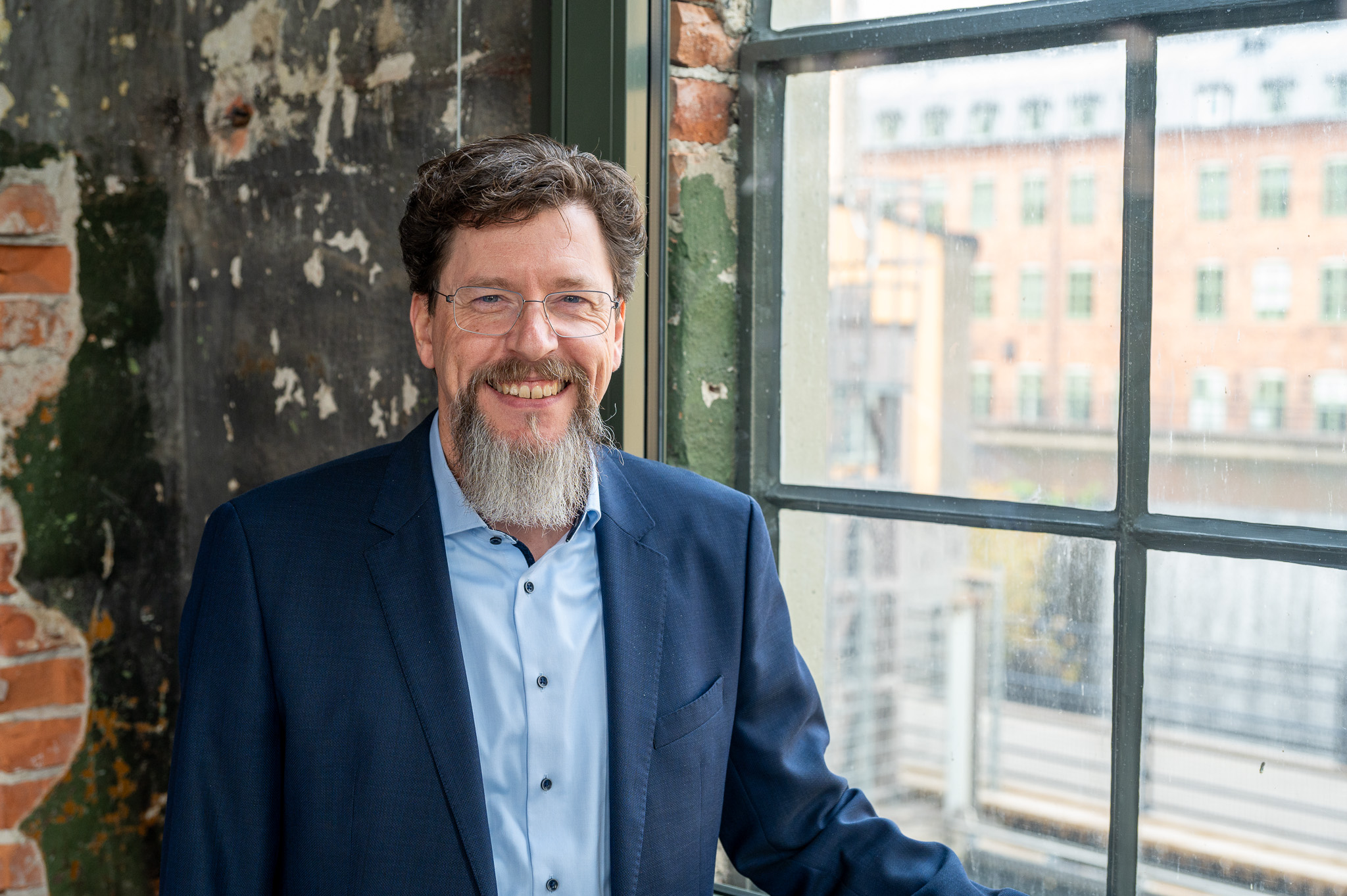
With a strong interdisciplinary background, Andreas Kerren has spent more than 20 years contributing to the fields of information visualization and visual analytics. We spoke with him about his engagement in ELLIIT, including inter-university research collaborations and the organization of a focus period.
Andreas Kerren, Professor of Information Visualization and Chair of the Information Visualization Group (iVis) at Linköping University (LiU), joined the university at the end of 2020 and became an ELLIIT Recruited Faculty member in January 2021. Since then, he has been active in multiple research projects within ELLIIT.
Please, describe your projects briefly.
After joining ELLIIT in 2021, I received funding for a PhD project currently carried out by my PhD student, Zeyang Huang. Her work focuses on visualization, interaction, and explainability in the context of high-dimensional embedding spaces derived from various data modalities such as graphs and networks, images, and texts.
In addition, through the ELLIIT Call D, my collaborator Richard Pates from Lund University and I received funding for the D4 project “Visual Analytics of Large and Complex Multilayer Technological Networks”. Our PhD student, Jinyi Wang, is developing new visual analytics methods for exploring and analyzing so-called multilayer networks, with applications in domains such as power systems.
What research area are you particularly interested in?
My main research interests include information visualization and visual analytics, with a particular focus on visual network analytics, text visualization, explainable AI/ML through visual analytics, and the use of embedding technologies in visual analysis.
Where did you find your interest in these areas?
At the end of my undergraduate studies, I completed my thesis in a programming languages and compiler construction research group at Saarland University, Germany. The thesis project focused on visualizing and animating complex algorithms and computational models—such as finite state or pushdown automata and semantic analysis algorithms—for educational purposes. I found this combination of mathematical and technical challenges with human-centered analytical and learning workflows both fascinating and rewarding. I continued this line of research during my PhD, contributing to the field of software visualization. Over time, my work broadened further, eventually leading me to focus on information visualization and visual analytics during my postdoctoral research.
In your own words, please summarize your work within these areas.
I have been an active researcher in these areas for more than 20 years, contributing in many ways and directions, which makes it challenging to summarize my work briefly. In general, my research combines human-centered data analysis with interactive visualization to help users derive meaning from data and support informed decision making. My students, collaborators, and I design and develop visualization techniques that account for user needs and task requirements, enabling efficient exploration and analysis of complex data sets.
Beyond classical visualization topics such as multidimensional data visualization, I have focused on multilayer and multivariate network visualization, text visualization, software visualization, and, more recently, explainable AI. Using visualization to make machine learning and related computational models more transparent and understandable—and thereby increase trust in their results—is both fascinating and demanding.
Finally, I want to highlight the strongly interdisciplinary nature of my work: I have had the pleasure of collaborating closely with excellent industrial partners and researchers from fields ranging from linguistics and social sciences to the life sciences and engineering.
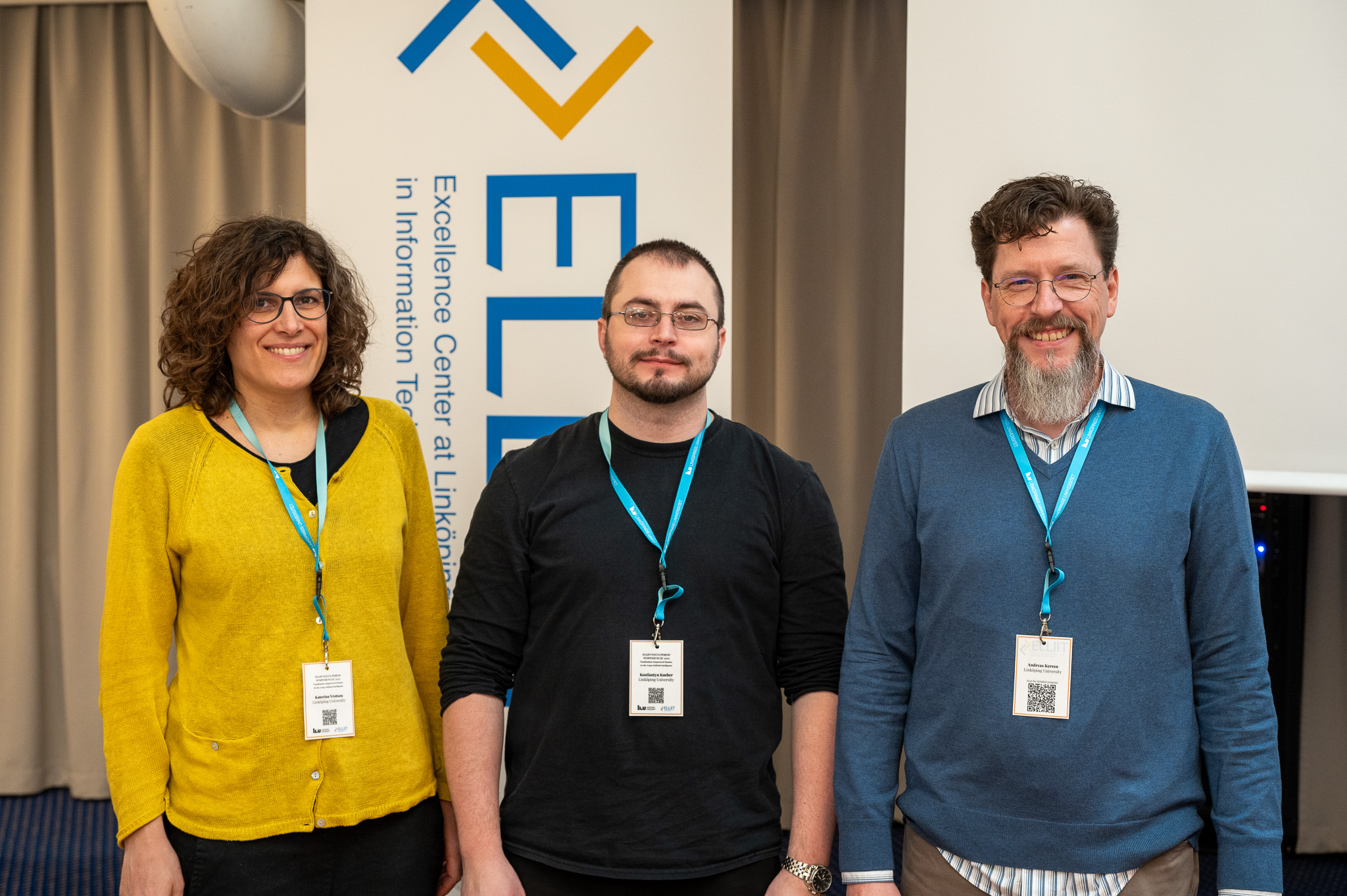
In April and May of 2025, you where one of the organizers of an ELLIIT Focus Period. What can you tell us about that experience?
I co-organized the ELLIIT Focus Period on Visualization-Empowered Human-in-the-Loop Artificial Intelligence in Spring 2025, together with Katerina Vrotsou and Kostiantyn Kucher (pictured above). It was a truly unique experience to bring nearly 20 scholars, including all the internationally renowned symposium speakers, to Norrköping to discuss the focus period theme in both breadth and depth. The effort was absolutely worthwhile. We were fortunate to receive substantial support from ELLIIT and the administrators Tove Kvarnström and Denise Wahlström.
The focus period also had significant international visibility and impact: at conferences and other events abroad, I was frequently asked about the focus period, how it was organized, and how it was funded. Its outcomes include several papers (one already published), new promising research collaborations, and plans for submitting an EU grant proposal.
Is there anything else you’re working on that you’d like to highlight?
In 2025, my group and I were very active in organizing the ELLIIT Focus Period as well as the 33rd International Symposium on Graph Drawing and Network Visualization (GD 2025), both held in Norrköping. After this busy year, I plan to take a short break from organizing large events. Nevertheless, in 2026 I will co-organize a workshop (and a corresponding special journal issue) on bridging graph drawing and dimensionality reduction in information visualization.
What are your ambitions with ELLIIT in the future?
My research is closely related to several areas highlighted in the ELLIIT 2030 Technology Foresight and the 2023 Compendium, such as to “[VIS- and] AI-driven Decision Support”, “Big Data and Network Science”, “XAI/HITL-AI” or “VA Systems for Decision Making”, among others. In this context, I hope to establish new ELLIIT projects in the future that address research questions in these areas, potentially fostering stronger inter-university collaboration within the ELLIIT environment.
I also aim to expand my research into additional application domains that have not been our primary focus so far, such as data analytics challenges in organic electronics, autonomous vehicles and robotics, cybersecurity, and game development.
And finally, what do you enjoy doing in your free time outside of academia?
I enjoy gardening around our home in Norrköping, especially taking care of the many perennials and roses in our garden. My wife and I also love to travel whenever time allows, and we consider ourselves foodies to some extent—something that often goes hand in hand with our trips, whether we are visiting Japan, France, Italy, or other destinations.
Contact and more
Read more about Andreas Kerren’s research and projects, and find contact information here.
Previous Meet the Recruited Faculty
See more interviews from our series Meet the Recruited Faculty here.
ELLIIT Focus Period
Read more about the ELLIIT Focus Period on Visualization-Empowered Human-in-the-Loop Artificial Intelligence.