
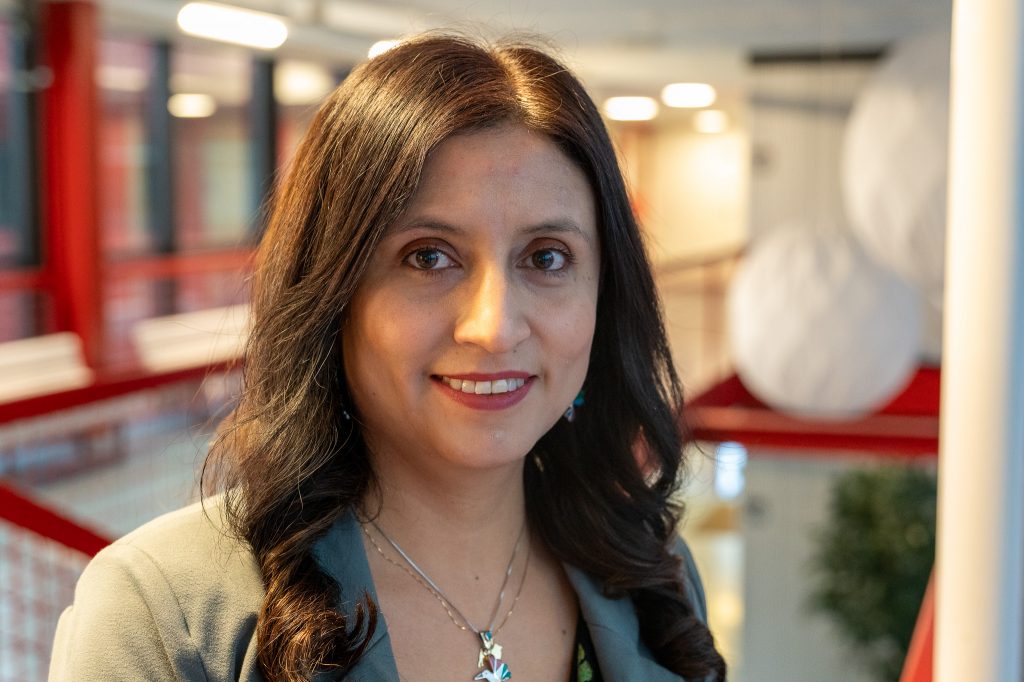
As she is finalizing the preparations for Linköping University’s next focus period, Diana Pamela Moya Osorio is looking forward to initiating new collaborations and research challenges. We spoke to her about Wireless Sensing Technologies for Emerging Applications and, possibly, the new 6G standards.
Diana Pamela Moya Osorio, Associate Professor in Communication Systems at Linköping University, joined the university and became an ELLIIT Recruited Faculty member in October 2023. “ELLIIT played a decisive role in enabling my move to Sweden,” she says. Here, she has found a strong and inspiring research environment, high-quality education, and a welcoming workplace. Beyond academia, Sweden has provided a good quality of life, with beautiful nature and a peaceful home for her and her family.
Do you have any active projects within ELLIIT? Could you please describe them.
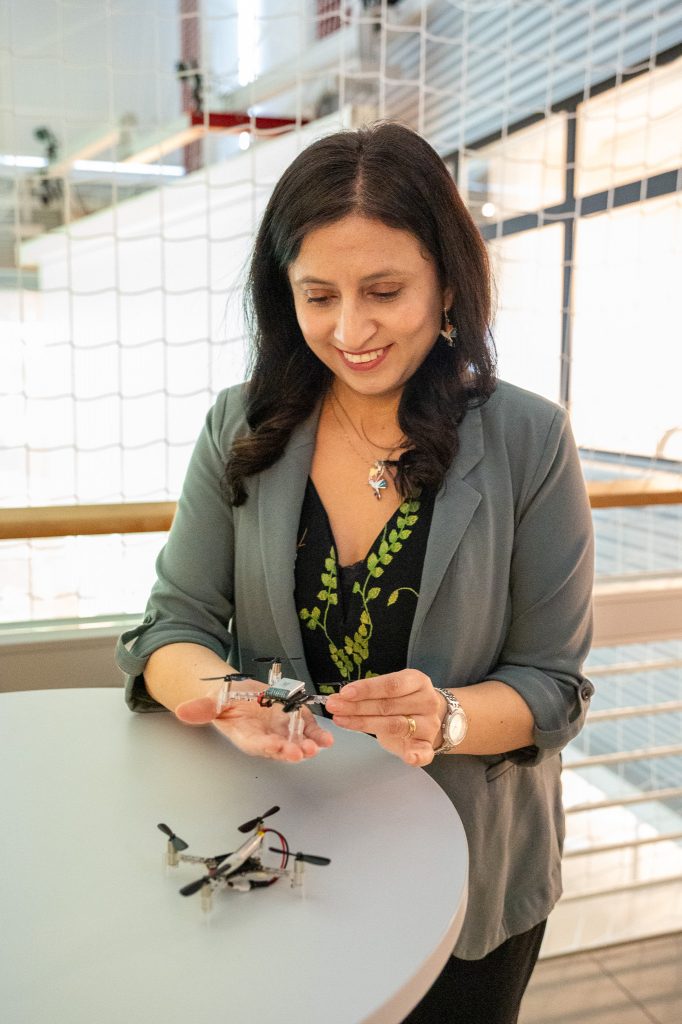
I do. The project HIGH-SENSE was granted under the ELLIIT Call-E, in 2024. The project studies frameworks that make effective use of frequency diversity in multiband integrated sensing and communication (ISAC) systems to enable high-resolution sensing. By sensing, we mean the ability to detect, locate, and track objects, as well as to observe physical characteristics of the surrounding environment. In an ISAC context, this capability is embedded in the mobile network itself, allowing the network to be aware of its environment and to react accordingly. This is particularly important for applications involving autonomous systems, for example, drones. By combining the complementary properties of different frequency bands, such as coverage and sensing resolution, we aim to develop strategies that meet the practical performance requirements of these applications.
What research area are you particularly interested in?
I am a researcher with a strong background in communication systems and over 16 years of experience in the field. Throughout my career, I have been driven by a desire to understand how the real world works and how it can be modelled based on fundamental physical principles. For example, I study how electromagnetic waves propagate and how they can be used for two essential purposes: transmitting information in communication systems and acquiring information on physical targets, including range, velocity, and angle in radar systems. Over decades, these technologies have evolved significantly, becoming an integral part of society and enabling a wide range of applications across both civil and military domains.
A key question driving my research is how these systems can coexist as they become increasingly ubiquitous and how they can converge to use resources efficiently while minimizing interference between them. Within this context, as we move toward an era in which intelligent systems interact with humans and make autonomous decisions, ensuring reliable perception of the environment, security, privacy, and resilience becomes critical. My research focuses on designing these systems to be robust, secure, and on the overall trustworthy, enabling them to effectively serve and protect society.
Where did you find your interest in this specific research area?
My career has been shaped by curiosity, a joy for discovery, and an ongoing capacity to adapt. I enjoy engaging with difficult problems, and my perspective has been influenced by living in several countries, experiencing different cultures, and learning within diverse educational systems and role models. These transitions, both personal and professional, strengthened my ability to understand new environments and to respond to different situations.
In the same way, technology is constantly evolving. It is shaped by advances in autonomy and intelligence, as well as by changing geopolitical dynamics that influence how we design and use modern systems. This changing world has drawn my attention toward technologies that help us sense and perceive the physical world with greater precision. My focus is on making the information we obtain more reliable, accurate, and trustworthy, so that people can trust in the technologies we create. I am also motivated by the potential of dual use technologies to support emerging needs and challenges for defense and aerospace.
In your own words, please summarize your work within this research area.
Together with my research group, which includes three PhD students, and in collaboration with colleagues, we address challenges related to wireless sensing systems. Particularly, we study how modern wireless networks can operate as a distributed sensor array, enabling radio based environmental perception and precise localization of users and devices. This paradigm is currently referred to as integrated sensing and communication (ISAC), and it is being discussed on the standardization of 6G. This concept aims to leverage existing infrastructure for both information transmission and sensing. Thus, ISAC can support AI-driven applications and future autonomous systems by providing continuous, network-wide perception data.
Our work particularly tackles distributed sensing scenarios in which sensing tasks are allocated across multiple network nodes. This introduces challenges in synchronization for coherent processing, data fusion, and node coordination. We also are interested on the challenges of drone detection and tracking using mobile networks, analysing requirements on waveforms, cooperation mechanisms, antenna configurations, and resource allocation between sensing and communication. ISAC alone will not solve all challenges in drone surveillance, as the strict requirements conflict with the main purpose of the network: connectivity. However, we aim to understand the degree to which mobile networks can contribute to this emerging use case.
A key research area focuses on how cooperation across spatial, frequency, and temporal dimensions can enhance sensing resolution, robustness, and coverage. We are also investigating the emerging security and privacy challenges introduced by ISAC use cases, particularly those arising from shared sensing communication signals and network wide perception capabilities. Our work relies on methodological tools from statistical signal processing, algorithm design, and optimization.
You are organizing the 2026 Focus Period at Linköping University. How is that work coming together?
We are delighted to welcome the entire community interested in discussing Wireless Sensing Technologies for Emerging Applications. Over the course of three weeks, we will host 21 talented research scholars, creating opportunities for networking through seminars, joint activities, and informal day‑to‑day interactions. Our goal is to initiate new collaborations and together identify novel research challenges.
In addition, the ELLIIT Symposium will bring 17 highly recognized speakers to share the latest advancements from both the radar and communications communities and to explore how these fields are converging. This ambitious program offers a unique opportunity to gain insights into the future direction of these technologies, driven by emerging applications.
We are currently finalizing the preparations for the ELLIIT Focus Period and getting ready to welcome participants to what we expect to be a very fruitful and inspiring event.
Is there anything else you’re working on that you’d like to highlight?
Among several ongoing initiatives, I have been developing new Master’s and PhD‑level courses in Radar Systems and Sensor Arrays. We have identified a significant lack of training in these highly relevant areas, which presents a great opportunity for Linköping University to educate future experts who can support our local industry, Sweden’s strategic technological priorities, and Europe’s broader competence base. I am proud of this work and hopeful that these courses will serve our students and Society in a meaningful way.
I have been involved in project proposals with few companies. We currently have a project with Altair focused on coherent processing for multistatic radar, and we have submitted a proposal with ReQuTech AB related to satellite communications. These are important areas where collaboration between industry and academia can lead to significant advancements. I hope we will have the opportunity to further expand our interactions with industry in the future.
Also, I want to acknowledge how proud and happy I am to work with my talented PhD students. I am also grateful for their support in helping build our research group.
What are your ambitions with ELLIIT in the future?
I am committed to contributing to the strategic vision of ELLIIT by initiating new collaborations with researchers at other institutions and by launching initiatives that will allow my group to engage in experimental research. I am confident that ELLIIT provides the ideal ecosystem and infrastructure to make this possible.
And finally, what do you enjoy doing in your free time outside of academia?
I love spending time with my family and always look for moments to be with them, no matter how full my schedule is. We enjoy being out in nature, and Sweden offers so many wonderful ways to appreciate it. I love hiking and discovering new trails. I also enjoy sports that help me relax. Running is a perfect way to combine exercise with time outdoors, and I love swimming as well. In addition to that, I enjoy learning Swedish language and culture, painting, learning piano together with my son, and I would love to learn woodworking in the future.
Contact and more
Read more about Diana Pamela Moya Osorio’s research and projects, and find contact information here.
Previous Meet the Recruited Faculty
See more interviews from our series Meet the Recruited Faculty here.
ELLIIT Focus Period
Read more about the ELLIIT Focus Period on Wireless Sensing Technologies for Emerging Applications.