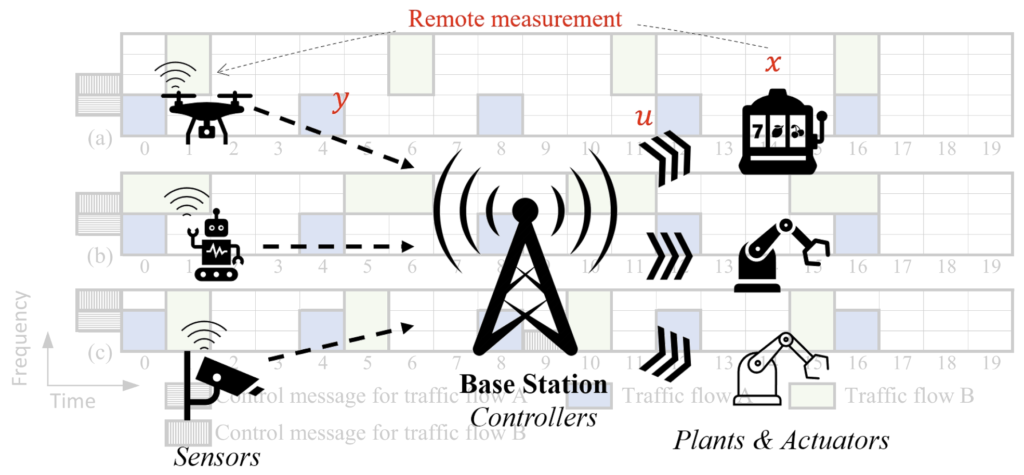
Can time-critical control systems really be moved to the cloud without sacrificing security or performance? At Linköping University and Lund University, this question has become a driving force not only for research, but also for education.
Within the ELLIIT project Robust and Secure Control over the Cloud, researchers have explored how the virtually unlimited computational power of cloud platforms can be used for advanced feedback control – while guaranteeing robustness, low latency, and protection against cyber threats. At the same time, the project has significantly influenced master’s and Ph.D. education at both universities.
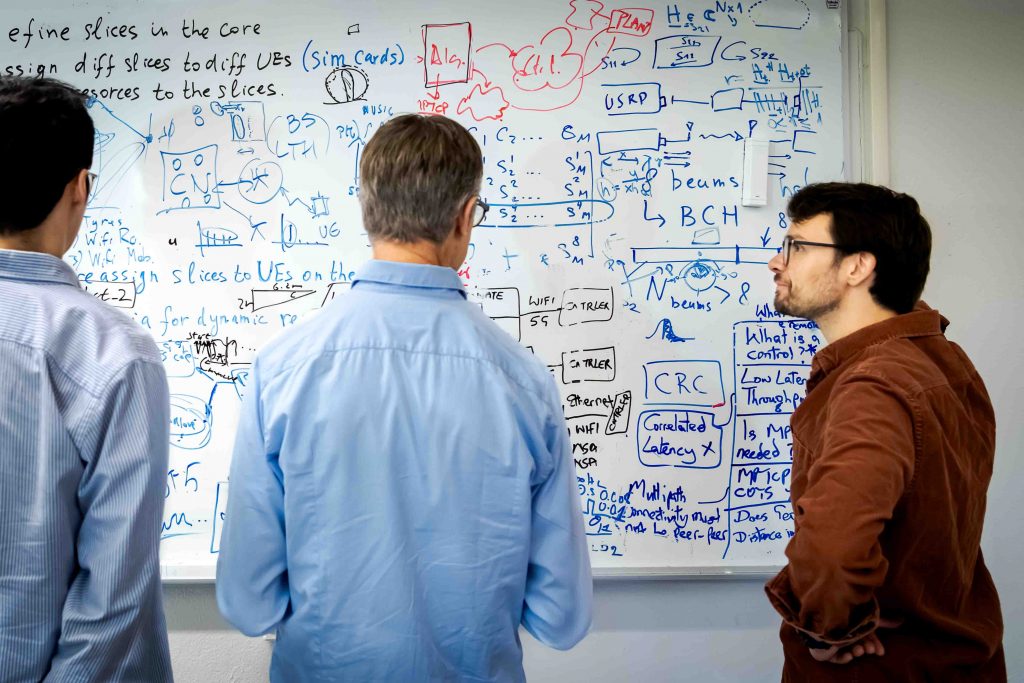
Photo: Kennet Ruona
From Research Frontier to master’s Courses
Outsourcing computationally demanding control tasks, such as Model Predictive Control (MPC), to the cloud opens new possibilities – but also raises fundamental security concerns. One key research contribution has been the use of verifiable computation techniques, enabling a local system to verify that a cloud-based controller has executed its computations correctly.
The main line of research has been on the co-design and joint optimization of computation resource, communication infrastructure and control quality. These research results have been integrated into master’s level education, including the course Advanced Computer Architecture at LiU. Students are introduced to real challenges at the intersection of computer architecture, control theory, embedded systems, communication networks, and cyber-security – areas that are increasingly intertwined in modern engineering systems.
A Strong Doctoral Environment
The educational impact is particularly visible at the Ph.D. level. Two doctoral students are directly financed by the ELLIIT project, one at each university. In addition, the broader research collaboration has resulted in multiple completed Ph.D. theses in recent years, covering topics such as:
- Secure cloud-based control using verifiable computation
- Offloading-based control over cloud and edge infrastructures
- Adaptive control of cloud server resources
- Security-aware design of embedded and networked control systems
The collaboration between computer science and automatic control has created an interdisciplinary training environment where doctoral students learn to combine control design, communication constraints, scheduling, and software architecture. This cross-disciplinary competence is essential for the next generation of cyber-physical systems.
Experimental Platforms and Industry Collaboration
The project has also emphasized experimental validation, where physical processes are controlled remotely over the cloud. This hands-on dimension has strengthened both master’s thesis projects and doctoral research.
Several student projects have been carried out in collaboration with industrial partners such as Ericsson, ABB, SAAB, and General Motors. Through these collaborations, students have worked with real-world challenges related to 5G scheduling, real-time guarantees, and secure cloud-based control architectures.
By connecting advanced research with course development, doctoral training, and industrial collaboration, the project demonstrates how ELLIIT funding contributes to long-term impact in education. Students are not only learning established theory – they are being trained at the research frontier of secure and robust cloud-based control.