
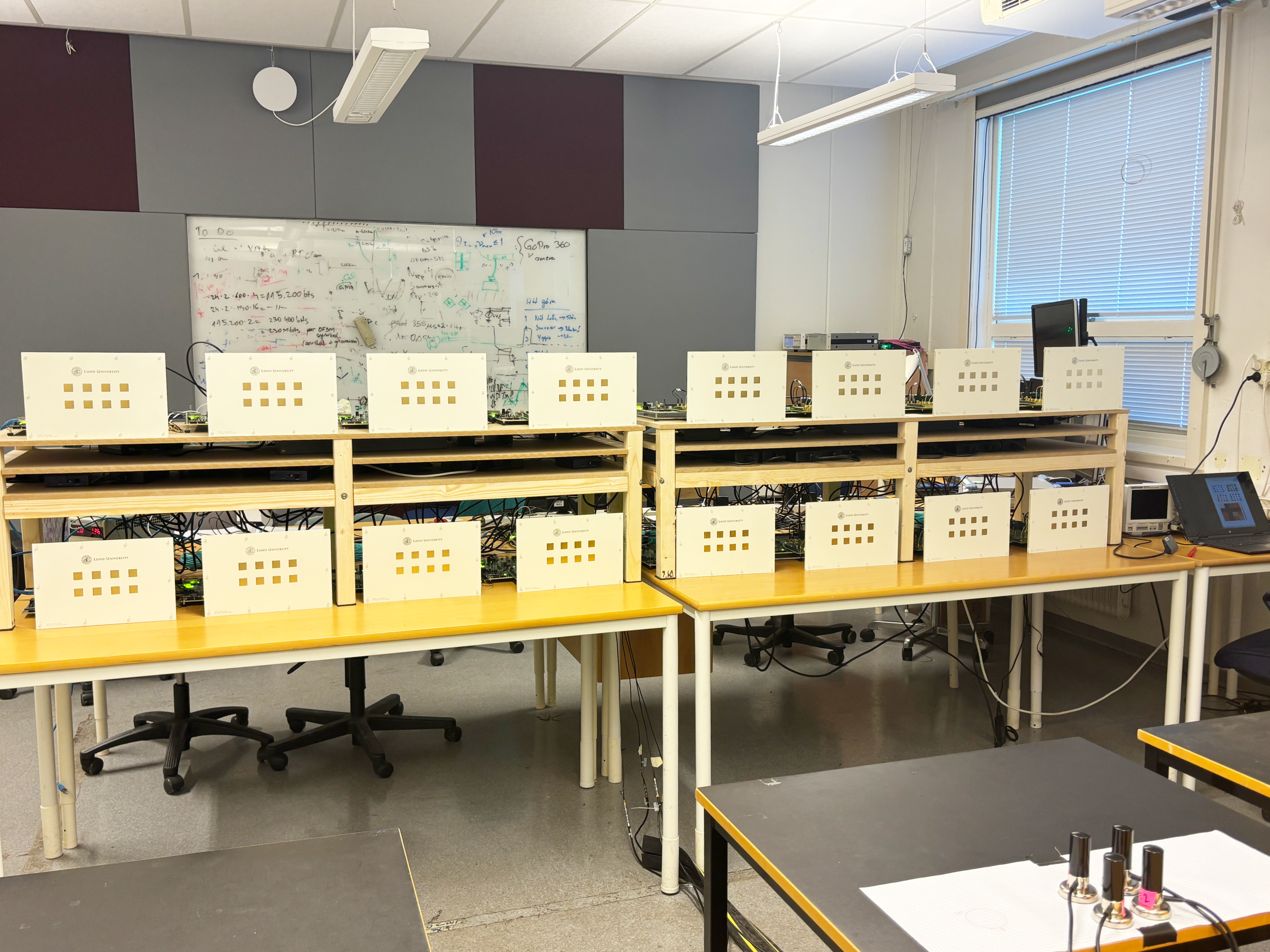
With increasing demands on future wireless communication systems, there is a growing need to demonstrate and investigate new technologies for 6G. Researchers at the Department of Electrical and Information Technology at LTH, Lund University have constructed a new distributed multi-antenna testbed and, for the first time, demonstrated that a wireless network with digitally steered radio signals and 256 antennas is feasible.
ELLIIT researchers at Lund University have developed a testbed capable of meeting the research requirements needed to advance future wireless networks and 6G technologies.
“We have demonstrated that the technology works with 256 antennas distributed across different locations, with data coherently processed in real time,” says Dumitra Iancu, PhD student in Integrated Electronic Systems.
Future wireless networks face stringent requirements: the number of users continues to grow, connected industry and autonomous vehicles demand reliable and secure networks. At the same time, radio frequencies used for wireless transmission are a limited resource. The testbed can now demonstrate properties that may be crucial for future 6G systems.
“Using the testbed, we can investigate how to improve the efficiency of existing spectrum usage for transmitting radio signals, enabling more users and greater network capacity,” says Ove Edfors, Professor of Radio Systems.
In terms of scale, the testbed named LuLIS after Lund University Large Intelligent Surface, is in a class of its own. It consists of 16 programmable panels with 16 antennas each, based on specialized hardware from the company AMD. LuLIS is developed in a modular fashion, allowing components to be added and distributed across an environment.
“The setup is also flexible since it is software-defined, meaning that changes in for ex-ample how data is transmitted can be implemented more easily compared to replacing hardware,” says Lina Tinnerberg, PhD student in Integrated Electronic Systems.
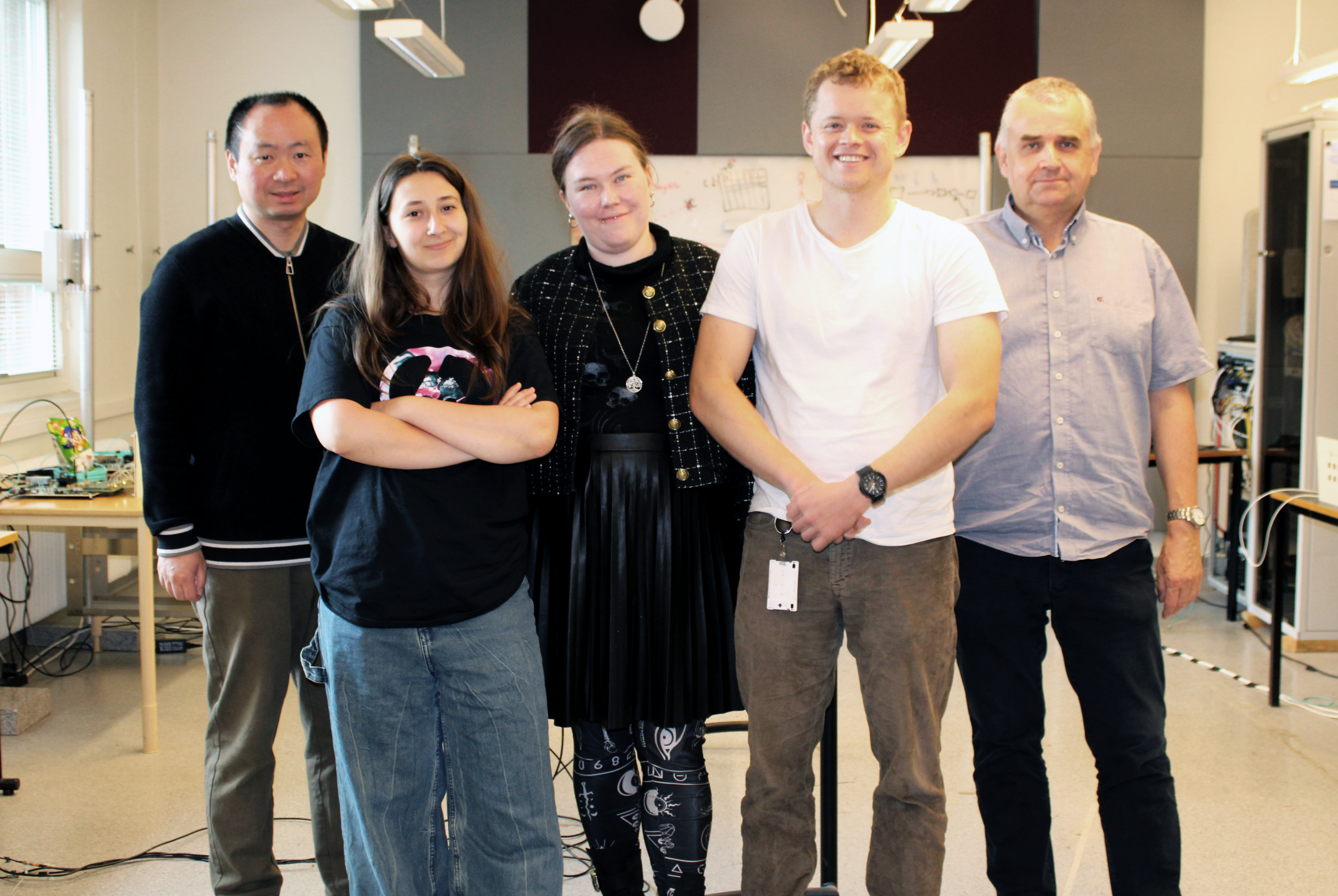
From left: Liang Liu, Dumitra Iancu, Lina Tinnerberg, Vilgot Snygg and Ove Edfors are in the core team working on the novel distributed testbed.
“An important aspect of practically building and demonstrating different technologies is that it allows us to identify challenges and practical issues that may not appear in theoretical studies. We have encountered and solved problems related to signal synchronization and distributed computation,” adds Liang Liu, Professor of Integrated Electronic Systems.
World Record Holders 2016
When today’s 5G technology was emerging, the use of hundreds of antennas simultaneously was considered purely theoretical. It was widely regarded as impossible to use so many antennas for wireless communication due to the required synchronization and computational capacity, not to mention separating signals from different users. The same research group at LTH was the first to demonstrate, using a testbed, that the technology massive MIMO (multiple-input multiple-output) with a large number of antennas can be realized in practice. Today, this technology is a cornerstone of mobile 5G networks.
“Unlike other massive MIMO testbeds, LuLIS distributes both antennas and computations across multiple panels, where data is processed in real time, reflecting real-world requirements,” says Vilgot Snygg, PhD student in Integrated Electronic Systems.
The predecessor, LuMaMi (Lund University Massive MIMO testbed), still holds the world record in spectral efficiency ten years later, achieved in collaboration with the University of Bristol. Spectral efficiency describes how much data can be transmitted per unit of frequency and time. Using LuMaMi, 22 simultaneous users were separated within the same frequency band.
“With the new setup, we expect to handle 32 users in the near future. With further up-scaling of the testbed, our goal is to surpass the 2016 record by an order of magnitude,” says Ove Edfors.
Dumitra Iancu, Vilgot Snygg, Sijia Cheng, Lina Tinnerberg, Mikael Henriksson, Emil Bergman, Anders J Johansson, Baktash Behmanesh, Ove Edfors, Liang Liu (2026).
A Scalable 256-Antenna Distributed MIMO Testbed with Real-Time Fully Digital Beamforming. https://arxiv.org/html/2605.02388v2
- The largest funding source for the development of the 5G and 6G testbeds has been the Swedish Foundation for Strategic Research (SSF), with support from ELLIIT.
- Industry partners Ericsson and Sony supported the project from the outset, and the AMD University Program has contributed a large part of the hardware solutions (RFSoC) used in the testbed.
- In addition to those interviewed, PhD students Sijia Cheng (LTH) and Mikael Henriksson (Linköping University) have contributed significantly to the development work, together with several master’s students.