
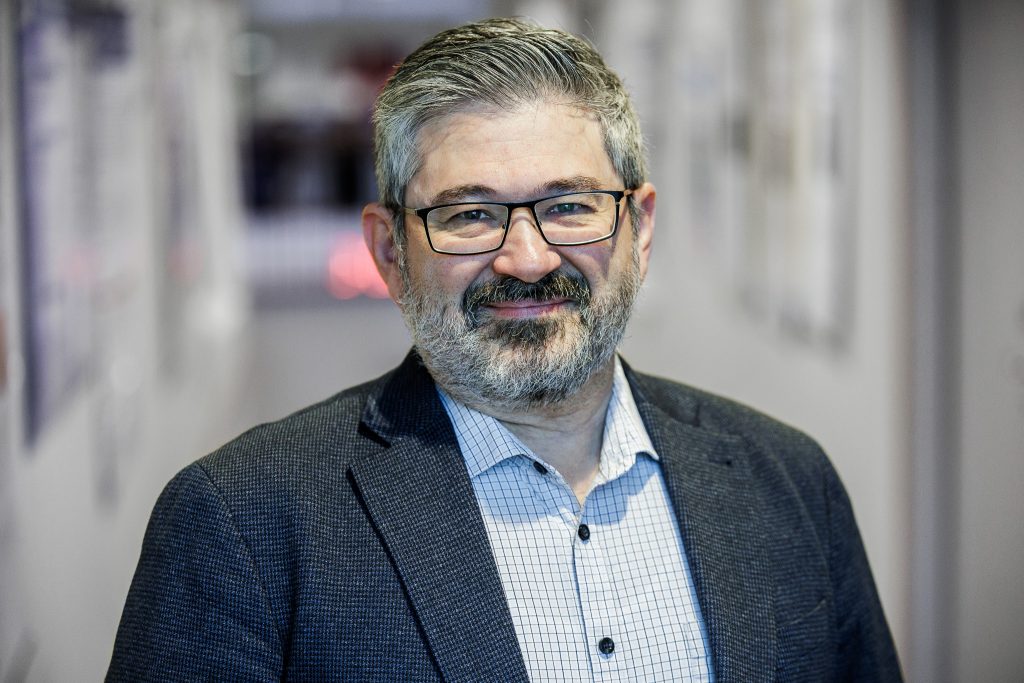
With an ambition to develop a strong research environment in Norrköping, Andrés Alayón Glazunov is building a research group with expertise in wireless communications and related technologies. We spoke to him about shaping the multidimensional wireless future, joint communications and sensing, and more.
When he took the position as Senior Associate Professor with the Department of Science and Technology at Linköping University, based at Campus Norrköping, Andrés Alayón Glazunov joined the ELLIIT Recruited Faculty in April 2023. He came from the University of Twente in the Netherlands, where he holds a guest appointment.
Do you have any active projects within ELLIIT? Could you please describe them.
Yes. I lead the ELLIIT project, “Unconventional Array Antennas for Pervasive Imaging Multiple-Input Multiple-Output Radar Systems”, together with Professor Fredrik Tufvesson at Lund University. At LiU (Linköping University), the project forms the basis of Omar Rifai’s doctoral research.
We investigate how the positions of transmitting and receiving antenna elements can be chosen to improve radar imaging. Rather than relying only on regularly spaced elements, we explore sparse, aperiodic arrangements. The aim is to obtain useful imaging performance with fewer antenna elements and radio-frequency channels, while accounting for propagation conditions and interference. A central question is how much hardware we can remove while retaining the information needed to distinguish targets reliably. The collaboration brings together antenna design and radio propagation expertise at LiU and Lund.
What research area are you particularly interested in?
My research contributes to shaping the multidimensional wireless future, where Maxwell meets Shannon, through the design and characterization of intelligent devices and environments for communications, localization and sensing. This means connecting the physics of electromagnetic waves with the information that wireless systems can transmit and extract from their surroundings. My work spans antenna systems for traditional communications and sensing applications and, more recently, joint communications and sensing, where these functions are designed and optimized together.
An antenna’s performance depends on how it exchanges electromagnetic energy with its surroundings. The materials, structure and geometry of an antenna array, the directions and polarizations of the waves, and the surrounding objects all influence what information the system can transmit or recover. I want to understand the physical limits governing these interactions and translate that understanding into practical design and measurement methods. This connects electromagnetic theory with signal processing and communication theory.
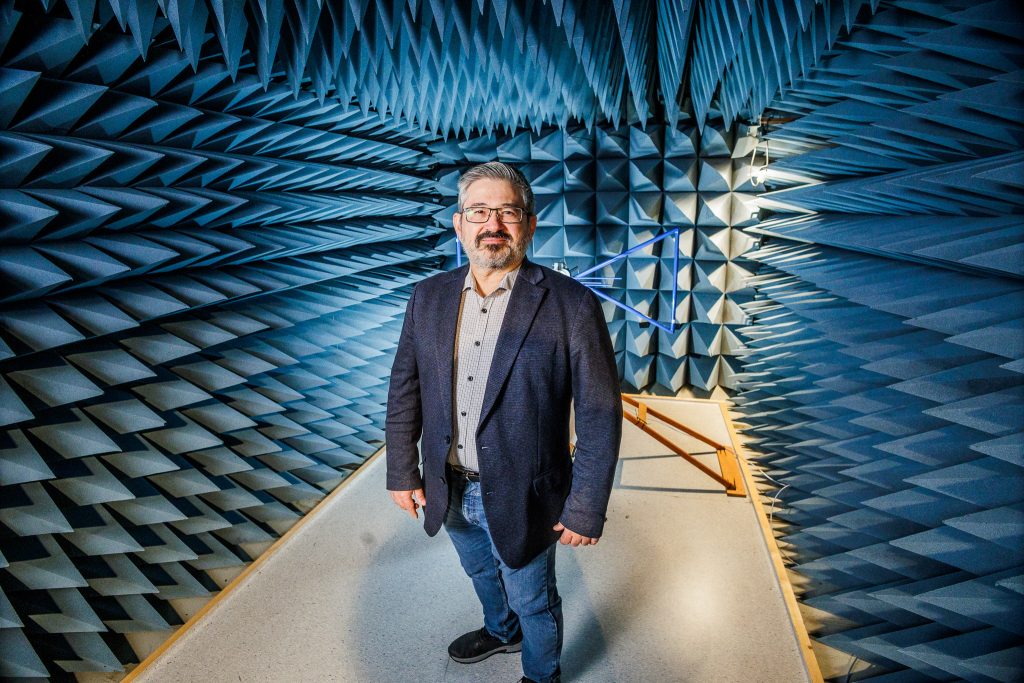
An important research direction is the over-the-air (OTA) characterization of wireless devices and antenna systems. I develop measurement methods for controlling electromagnetic environments to evaluate how complete devices perform through their antennas under relevant propagation conditions. This work connects antenna design and propagation modelling with experimental assessment of communications and sensing performance.
My research also extends to the wireless performance of buildings. I study how building layouts and materials affect useful signals, interference and energy efficiency, and how wireless performance can be considered during building design.
Where did you find your interest in this specific research area?
My route into this field began with physical electronics, which I studied during my engineering education. I later moved into telecommunications research at Ericsson and then Telia, working on radio propagation, receiver performance and antenna measurements.
That experience brought me close to a practical question: how do the antenna and the propagation environment together determine the performance of a wireless device? It became the subject of my doctoral research at Lund University, where I studied antenna–channel interactions using spherical vector waves. The connection between a fundamental physical description and a measurable engineering outcome remains central to my work.
In your own words, please summarize your work within this research area.
My work on intelligent devices and environments connects the physics of electromagnetic waves with the design and characterization of systems for communications and sensing. It spans established communication and radar applications and, more recently, joint communications and sensing. At the theoretical level, I have developed methods for describing how antennas couple to propagation channels, including approaches based on spherical vector wave expansions. These help us study how spatial structure and polarization affect the information carried by the electromagnetic field.
With my students and collaborators, I also design antenna arrays and radomes for applications such as millimetre-wave communications, automotive radar and satellite systems. Another substantial part of my work concerns over-the-air testing: measuring a complete wireless device through its antennas under controlled conditions that represent relevant propagation environments. This includes contributions to early 3GPP antenna measurement methods, Random Line-of-Sight testing and hybrid anechoic–reverberation chambers.
A further strand of my research is building wireless performance. Together with collaborators, I have helped develop ways to quantify how building layouts and materials affect indoor wireless networks. Our work includes power gain and interference gain as figures of merit, analytical methods for evaluating building layouts, and studies of wireless energy efficiency. The aim is to make wireless performance a consideration during building design, alongside established requirements such as thermal performance. This research includes collaboration with Ranplan through the Eurostars BuildWise project.
The recurring goal is to understand how devices and environments together determine system performance, and to turn that understanding into better designs and meaningful characterization methods of antenna systems for communications, sensing and their joint operation.
Is there anything else you’re working on that you’d like to highlight?
Alongside the ELLIIT project, I lead an ÅForsk-funded project on array antenna system optimization for imaging MIMO holographic staring radars, with postdoctoral researcher Dr Amit Kumar Pandey. We are investigating antenna architectures for imaging an extended field of view while reducing the need for sequential beam scanning. It complements the ELLIIT work by exploring further connections between array design and radar imaging.
Industry collaboration is also an important part of my research. My collaborations include Gapwaves on millimetre-wave antenna arrays, Bluetest and Ericsson on over-the-air characterization, RanLOS on automotive testing, and Ranplan on wireless network modelling and the wireless performance of buildings. These connections help us formulate research questions that are scientifically interesting and grounded in practical engineering needs.
I also value bringing research into education through supervision and project-based teaching. Giving students responsibility for a real design or measurement problem helps them connect electromagnetic theory with hardware and system behaviour.
What are your ambitions with ELLIIT in the future?
My ambition is to develop a strong research environment in Norrköping for the design and characterization of intelligent devices and environments for communications and sensing, with close connections to the wider ELLIIT community. I would like to deepen the collaboration with Lund and develop further joint research that connects antenna systems, propagation, over-the-air characterization and signal processing, including joint communications and sensing.
One direction is to establish reliable design principles for unconventional antenna arrays: when they offer a real advantage, what limits their performance, and how those advantages survive practical implementation. Another is to develop testing methods for increasingly adaptive wireless systems, including systems that combine communication and sensing.
I would also like to extend the work on wireless building performance by connecting propagation modelling and network design with the design of buildings themselves. There is scope within ELLIIT to bring together expertise in electromagnetics, communications and optimization to study these questions.
I would also like to contribute to joint doctoral training and larger collaborative projects. ELLIIT offers the continuity needed to pursue fundamental questions while building the experimental capability and collaborations required to turn the results into useful technology.
And finally, what do you enjoy doing in your free time outside of academia?
I appreciate the arts and particularly enjoy photographing landscapes, cityscapes and everyday surroundings. I also enjoy travelling with my wife and children whenever time allows. We love walking in nature, exploring the architecture of big cities, enjoying the calm of the sea and discovering the character of the countryside. Sampling local food is always an essential part of our trips. Northern Spain is a region I particularly recommend for its varied landscapes, cultural richness and wonderful food.
Contact and more
Read more about Andrés Alayón Glazunov’s research and projects, and find contact information here.
ELLIIT Project
Read more about the ELLIIT project Unconventional Array Antennas for Pervasive Imaging Multiple-Input Multiple-Output Radar Systems.
Previous Meet the Recruited Faculty
See more interviews from our series Meet the Recruited Faculty here.