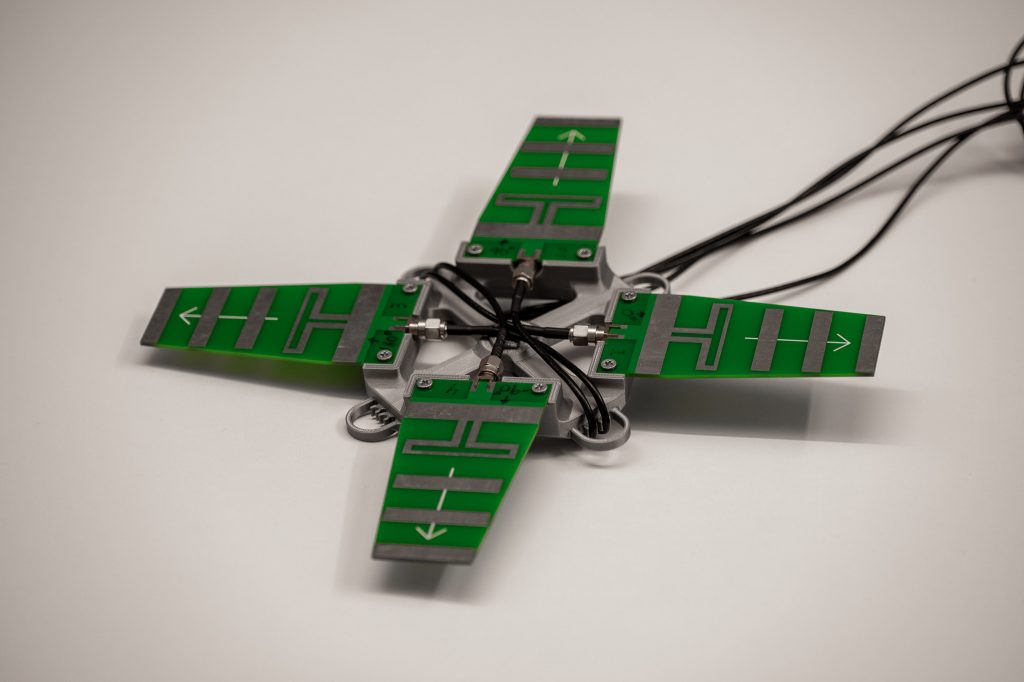
How can we determine where a sound, radio signal, or vibration is coming from? During his ELLIIT-funded PhD studies at Linköping University, Gustav Zetterqvist has developed new methods for estimating the direction of signal sources. The research could contribute to smaller and more practical sensor systems, with potential applications ranging from wildlife monitoring to locating missing people.

Finding the direction of a signal
Zetterqvist’s research focuses on direction-of-arrival estimation, determining the direction from which a signal reaches a sensor array. The principle can be applied to sound and radio signals as well as vibrations in the ground.
Traditional methods often compare the time at which a signal reaches different sensors. Zetterqvist has instead investigated how the directional sensitivity of the sensors themselves can be used. Because microphones and antennas are more sensitive to signals coming from some directions than others, differences in received signal strength provide information about where the source is located. This approach can enable considerably more compact sensor arrays.
His research has also explored how seemingly missing information can be useful. With Bluetooth, weak signals below a certain threshold are not registered by the hardware. By combining knowledge about this threshold with a sensor’s directional sensitivity, these missed measurements can provide additional information for estimating direction.

From elephants to search and rescue
The research has been tested across several signal domains. In one application, geophones were used to detect vibrations in the ground caused by animal footsteps. A prototype was tested using data from elephants at Kolmården, followed by field tests in Kenya.
Acoustic experiments have included signals such as a gunshot, an elephant trumpet, a siren, and a scream. The results have shown that the frequency content of a signal strongly affects the directional sensitivity of microphones.
While these methods have not yet been deployed operationally, they have several potential applications. A compact sensor array could, for example, help locate wildlife or guide rescuers toward a missing person carrying a device that emits a wireless signal. Acoustic localization could also help determine the origin of sounds such as gunshots. The next step is to make the technology easier to deploy and calibrate for practical use.
“The ELLIIT workshops have been an important opportunity to meet other researchers, present my work, and get new ideas and perspectives on my research.”
Gustav Zetterqvist
The role of ELLIIT
Zetterqvist’s doctoral research was conducted within ELLIIT project B11, Local Positioning Systems, and in October 2026 he defended his thesis, Directional Sensitivity for DoA Estimation: From Missed Detections to Tracks.
ELLIIT has also provided a research network around the PhD studies. Through annual workshops, Zetterqvist has presented his research, exchanged ideas with other PhD students and senior researchers, and gained new perspectives on his work. He has also exchanged experiences with a PhD student at Lund University working on related problems within the same ELLIIT project.
The doctoral training illustrates an important part of ELLIIT’s educational impact: supporting the development of new researchers while creating knowledge that can form the basis for future technologies and applications.