
AI systems are increasingly being used in scientific and industrial settings where errors can have serious consequences. This autumn, Halmstad University is hosting the ELLIIT focus period on Robust AI for Science and Industry, bringing together researchers from different countries and fields to explore how AI can become more reliable, understandable and trustworthy.
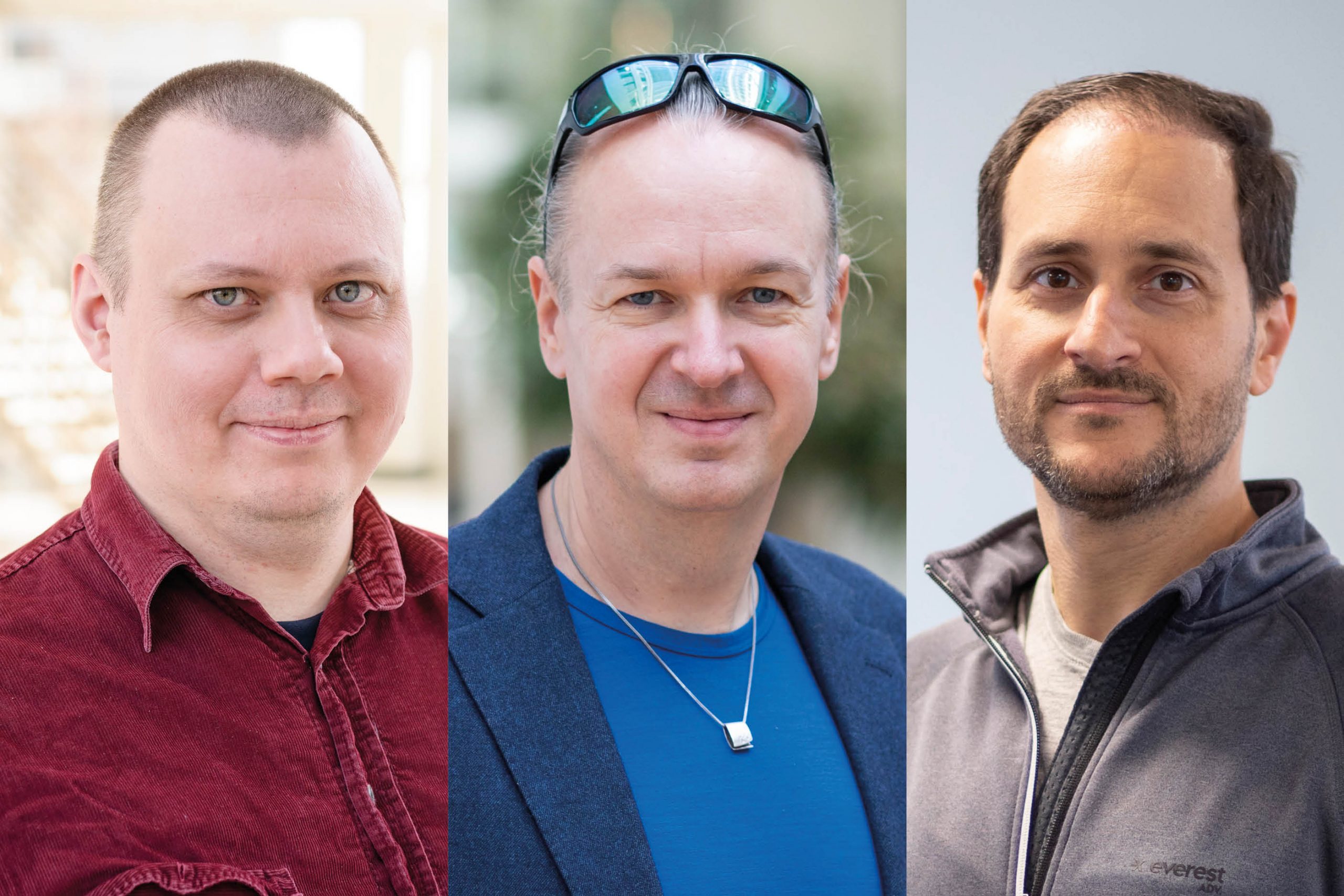
Focus period organizers Slawomir Nowaczyk, Grzegorz J. Nalepa and Edison Pignaton de Freitas. Photos: Joachim Brink och Dan Bergmark.
Artificial intelligence has developed rapidly in recent years, and data-driven methods are increasingly becoming tools for both scientific research and industrial applications. But as AI systems become more capable and are deployed in more demanding settings, a fundamental question becomes increasingly important: how can we know that they will work reliably outside the conditions in which they were developed? “
“The gap between what AI can do and what we can guarantee it will do safely is now a practical problem, not merely a theoretical one”, says Grzegorz J. Nalepa, Professor of Machine Learning at Halmstad University and lead organiser of the ELLIIT focus period in Halmstad.
One challenge the participants will discuss and explore this focus period symposium is that AI systems can encounter data and situations that differ substantially from those used during training. An AI system for medical imaging, for example, might perform well on images from one type of scanner but considerably worse on another without signalling that its reliability has changed.
“Robustness is not just about algorithmic performance. It is also about whether the system and its users can make sound judgements about when to trust it”, says Slawomir Nowaczyk, Professor of Machine Learning at Halmstad University and member of the organising committee.
Bringing different perspectives together
Severall open research challenges remain. Some AI systems are difficult to guarantee or verify under different conditions, while real-world industrial data can be irregular and limited. Researchers in the field also need better ways of measuring robustness and comparing different approaches. Among the research directions explored during the focus period are causal AI, which aims to reason about cause and effect, and neurosymbolic approaches that combine data-driven learning with structured domain knowledge. Explainability is another important area, particularly how AI systems can support an ongoing interaction with users rather than provide a single explanation.
“A cross-domain perspective on robustness is an important part of the focus period. Methods developed for one domain may be extended or adapted to others, creating opportunities for new research collaborations”, says Edison Pignaton de Freitas, Professor of Autonomous Systems at Halmstad University and member of the organising committee.
The organisers hope that the focus period will lead to new collaborations across ongoing and future PhD projects, as well as larger research and development projects involving European partners. The Halmstad 2026 focus period on Robust AI for Science and Industry takes place 7 September–9 October, with a three-day symposium on 22–24 September.
ELLIIT Focus Period
Find out more about the focus period themed Robust AI for Science
and Industry
Symposium
See the program for the focus period symposium September 22-24, 2026
in Halmstad.